
If you've ever wondered whether you need a coach, a therapist, a mentor, or a consultant, you're not alone. The words get used interchangeably often, but shouldn't. Here’s what each means, technically:
Coaching assumes you're resourceful and whole. The International Coaching Federation (ICF) describes it as a creative, thought-provoking partnership that helps people reach more of their personal and professional potential. It's future-focused and goal-oriented, and the client sets the agenda, with an emphasis on action and accountability.
Therapy assumes something needs healing. It's a collaborative treatment, built on the relationship between a client and a licensed clinician, that addresses psychological disorders and distress. It often works on pain, dysfunction, and conflict, and on resolving difficulties from the past so a person can function better in the present.
Mentorship assumes lived experience is what you need. It's guidance and advice from someone who has been where you're trying to go.
Consulting assumes a knowledge and/or execution gap. It's expertise, from someone who has the answers you need. A consultant diagnoses the problem and recommends the solution.
Each one is valuable. The trouble starts when we expect one to do the job of another.
My work isn't any single one of them. It's a Venn diagram where all of them overlap.
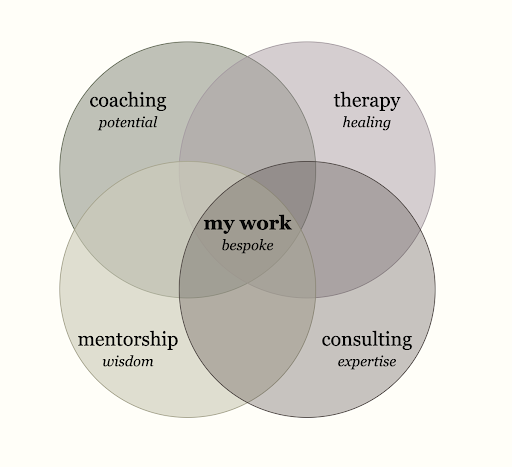
Depending on the person and the season, I might ask questions like a coach, share what I've seen work like a mentor, bring expertise like a consultant, and get curious about patterns and beliefs in a way that overlaps with therapy. (To be clear: I'm not a therapist. I don't diagnose or treat anything, and when someone needs that kind of support, I'll point them toward it.)
That's what makes the work bespoke. One client needs a thinking partner for a big decision. Another needs someone to say the true thing they've been avoiding. Another needs a practical framework and a deadline. The mix changes, and so does the work.
One more note: if something feels heavy enough to get in the way of daily life, start with a licensed therapist. A coach can be a great complement, but it isn't a replacement.
Questions for you to consider:
Do I need to heal something from the past and/or build something in the future?
Do I need answers, or do I need help finding my own?
Would it help to learn from someone who has already walked this path?
Could more than one kind of support serve me right now?
To getting the right kind of support, Darrah
PS I’m taking on 2 new clients for the first time in close to a year. If you’re interested in seeing if it’s mutually aligned, let’s have a conversation.